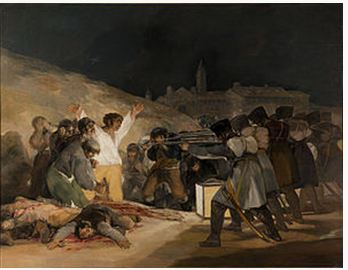
Francisco de Goya, born 1746 Fuendetodos, Aragón, Spain and is Spain’s most influential Master Painter and Printmaker of the 18th century. Goya is to Spain as Rembrandt is to the Netherlands. From an early age Goya studied to be a painter. At the age of 14 Goya entered into apprenticeship with Jose Juzan, a local Spanish Master Painter, and then later went to apprentice with Anton Raphael Mengs, popular artist with the Spanish Royals, laying a strong foundation in the niche of Spain’s Royal families.
 In 1763 and 1766 Goya was rejection by the Royal Academy of Art but did happen to enter and win 2nd place at a completion in the City of Parma, Rome. Later Goya began to paint with Francisco Bayeu y Subias, this who Goya picked up the color palette and tonalities that he became famous for.
In 1783 Goya was hired by the Spanish Crown to  create designs for tapestry’s and eventually created hundreds of works that not only changed art history but chronicled the political and social world. G
 oya’s artistic mastery was very scholarly and highly prized however this isn’t all he is known for. Goya took artistic liberties with his art by taking his personal views and outer imperfections of the royalty depicted and placed them within the art. Many of the people painted were subject to actual renditions of their likeness, sparing no mole melancholy smirk or crocked smile which was extremely radical of the
  time. But somehow he escaped the scrutiny of the court, perhaps because of his close relationship with Queen Sophia. The Queen was a huge admirer of Francisco de Goya’s work as was King Charles IV and eventually the Queen would save him from persecution later in his career.
 Francisco de Goya grew ill in1792 with a combination of nervous and physical troubles, which have yet to be diagnosed even today. This illness left Goya almost def and took hold of his art. His subject matters and palate became an outward depiction of his inner turmoil; bitter, secretive, and dark.
Like his successor Picasso, Goya took major 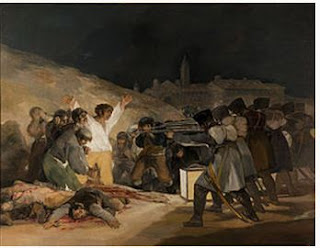 political stances with his art especially turning the later dark periods in his life. The Spanish Inquisition was well into fruition and drew Francisco de Goya further and further into a torturous dark place allowing for personal angst and desolation to fester inside. Goya combined his inner pain with the pain of the Spanish Inquisition, social anxiety, and widespread corruption of the Catholic Church giving way to the perfect rendition of dark and lucid trepidation of 80 etchings, Los Caprichos.
Feburary 6th, 1799 Goya finished work on his most famous and treacherous series Los Caprichos, created during the Spanish Inquisition. The works sold for 320 Reales about 35 dollars for the set, about 35 cents a print. Only 27 copies were sold and Goya stopped the sale of the works.
 This series is by far one of the most politically charged statements of its time. So much so that Goya withdrew the works from the public after selling only a handful party because of the inquisition and fear of the Crown implicating him in a plot against it and partly because of its failure to sell.
However, Goya did not slip by persecution as he hoped and was brought in for questioning. Fortunately due to Francisco de Goya’s relationship with the queen of Spain he was let go and gave the plates and prints  to King Charles IV. Some history books claim this was Goya’s decision but one can speculate that Francisco de Goya ‘agreed’ or was ‘persuaded’ to hand over the 80 plates to Spain as a barter for his freedom. While other historians state that the Spanish government demanded the unsold works and copper plates be handed over and thus saved Goya from a life of imprisonment or even death. (The Spanish government held the collection of etchings for many years before allowing the world to see them. In fact it wasn’t until the 1950’s did Spain allow the works to be seen in public.)
 Between 1815 and 1824 Goya created his final print series Los Proverbios a series of 18 etchings depicting satirical rendition of life in Spain and others nightmarish darkness or evil. The working proofs were called Los Disparates or “Follies” and thus known by the two titles. These works are also very much tied into his Black Paintings period created in the same time period. The Los Proverbios could be considered the print versions of the Black Paintings.
In1819 Goya had moved completely into himself working on a series of 14  paintings called the Black Paintings, again referencing witchcraft and war similar to that of the Los Caprichos series but much darker and less political. It is
  speculated that the 14 works were never intended to be on display by the artist, painted directly on the walls and never mentioned in writings. The Black Paintings are on permanent display at the Museo del Prado, housing the largest public collection on Goya’s art.
By 1845 Goya lost all faith and nationality with Spain and moved to Bordeaux (and only visited Spain twice after that) where he died in 1928 at the age of 82.

 (CNN) -- Artist Lucian Freud, known for his thick application of paints in painstakingly created, highly stylized portraits, has died at the age of 88, his publicist said Thursday. He died Wednesday night of an unspecified illness at his home in London.