Showing posts with label Artist. Show all posts

Tuesday, September 20, 2011

Galerie Michael opens its fall season with an Exhibition by Artist Alumni from the Florence Academy of Art


With a private evening reception on Thursday, September 15, Galerie Michael opened its doors for the inaugural exhibition of recent paintings and sculpture by artist alumni from the Florence Academy of Art (FAA) in Italy. The exhibition showcases twenty-two artists in the academy’s west coast debut whose works are reminiscent of the European masters of the Renaissance. Technically exquisite and thematically exploring mythological storytelling and a play on life, death, narcissism and the supernatural the exhibition highlights traditional craftsmanship, observation from nature and studio expertise that these artists continue.

In his opening speech gallery owner Michael Schwarz expressed his lasting commitment in presenting the works of the artists of the Florence Academy and respectfully spoke of the integrity, stimulating artistic discourse and dedication that these young artists have offered since his first visit to the academy in Florence. Equally proud of the collaboration and launching of the exhibition program was FAA founder Daniel Graves and executive director Susan Tintori who shared insights of the academy’s history and mission.

Invited guests flocked to the gallery opening delighted to meet several of the artists in person and to view the expansive new art display firsthand. During the evening clients and artists mingled in the upstairs galleries filled with impressive figurative paintings, still lifes and life size bronze sculptures. Off to an exciting new art season the exhibition continues on view through October 15, 2011.

A fifty page full color catalog is available.

Galerie Michael
224 N. Rodeo Drive
Beverly Hills, CA 90210

Mon – Sat: 10:00am to 7:00pm
Sun: 12:00pm to 6:00pm

Thursday, September 15, 2011

Maureen Hyde

Autumn, oil on canvas, 49"x27"


Maureen Hyde received an MFA in painting from the University of California at Los Angeles. She worked from 1984 to 1994, illustrating books for young adults, historical novels and classics, and also numerous picture books for children. In 1996, she began a course of study at The Florence Academy of Art, and received a Diploma in Painting in 1999.

Maureen began her teaching career at the University of California, and resumed as one of the principle instructors at the FAA in the Intensive Drawing Program. She also teaches summer workshops in portraiture and landscaping with The Florence Academy of Art and the Notre Dame School of Architecture. She has participated in numerous alumni exhibitions, and is being represented with many galleries throughout the United States and in London. Her work is also found in private collections throughout Europe and America.

“In living and working in Florence, Italy, my creative spirit feels at home. The light and natural beauty of the Italian landscape and architecture is providing limitless inspiration. I am engaged in an endless dance, chasing and choreographing light as it illuminates the natural world with glimpses of beauty.”

Justin Hess (b. 1981)


A Second Glance, oil on canvas, 35"x39"


Justin Hess was born in Ventura California in 1981. At the age of 19 he began his formal art training at Ventura College and later at the San Francisco Academy of Art University. In further pursuit of his studies, he was introduced to the Florence Academy of Art by a colleague, and left the SFAAU to move to Italy.

Justin entered the Florence Academy of Art in the fall of 2005 and was awarded “Best Drawing of the Year” at the end of his first year. He participated in Alumni exhibitions while still a student, and upon receiving his Certificate of Completion in 2008 was awarded “Most Improved in Figure Painting” during the graduation ceremony.

Justin has taught painting classes and lectured on Pigment and Canvas preparation, at the Florence Academy of Art in Italy, and Atelier Østrup in Norway. His paintings have been published in “The Artist’s Magazine” and “International Artist Magazine”, where the latter will have a featured article & painting demonstration in print this coming year. In January of 2011, Justin was juried into the Oil Painters of America as an Associate Member, followed by his painting being accepted into the OPA 20th National Juried Competition as one of the 158 participants out of 2,100 applicants.

At the age of 30, Justin has already exhibited in Italy, London, Monaco, Norway and the United States. Now, after having completed an intensive 6 years of study and work in Florence Italy, Justin will be returning to San Francisco in the summer of 2011 and opening a small Atelier offering workshops and private instruction in the classical realist tradition. Justin’s paintings can be found in private collections in Australia, Europe, Scandinavia and the United States of America.

Cornelia Maria Hernes (b. 1979)

Tooth Fairy, oil on canvas, 17"x13"


Cornelia was born in Norway in 1979. She graduated from The Florence Academy of Art, in 2007, and from University of Victoria, British Colombia in Canada in 2003, where she achieved a Bachelors of Fine Arts degree. In University she became acquainted with the paradigms of conceptual art, and became even more determined to pursue classical realism.

She began to paint with oil in her late teens. She is particularly interested in depicting human emotion and expression as a way to convey a mood, story or insight. Her interests have expanded over time to include the serenity of still lives and the intimacy of interiors. She currently lives and works in Florence, and teaches drawing and painting at The Florence Academy of Art as a principal instructor.

Friday, September 2, 2011

Robert Bodem (b.1971)


Let the Words be Yours, I am Done with Mine,2009, Bronze Sculpture


Robert Christian Bodem (b.1971, Minneapolis, Minnesota) graduated cum laude in Sculpture from Boston University in 1995 where he also received a Master of Arts in 1998. In that same year, Robert was a recipient of the prestigious Albert S. and Ester B. Kahn Award for his talent in figurative sculpture. During his undergraduate studies, he worked as an assistant to the sculptor Dimitri Hadzi. He later spent a year as a sculpture student at The Florence Academy of Art (1995-1996), to return in 1998 as the Academy's principal Sculpture instructor. He became Director of the Sculpture program in 2003.

His exhibitions include group and juried shows throughout Massachusetts and New York. Robert was selected to take part in the 2002 National Sculpture Society Annual Awards Exhibition in 2002. Group exhibitions include: “Realism Revisited”, Panorama Museum, Germany, 2003, "Realism Revisited", Hirschl and Adler Galleries, Inc., New York, and The Florence Academy of Art First Annual Alumni Exhibition, Florence, Italy, 2005.

“Nature is a great teacher, and working from direct observation allows me to unlock some of her mysteries. The forms that I am able to bring to the surface should clarify my interpretation of human relationships. To copy nature is an impossibility, but to seek an understanding of particular human emotions, to attempt to clarify emotional content through silent sculptural form, is within the artist's reach. I feel it is necessary to study life. Drawing on the inspiration I receive from the subject is an attempt to make poetry of the form, and ultimately, present the viewer with those essential forms that expand our knowledge of how we interrelate to one another.”


Thursday, September 1, 2011

Trail for Selling Fake Art


The trial of four people accused of selling fake artworks from the fictional "Werner Jägers collection" began this week in Cologne, promising to bring to light new details of the nefarious operation that ensnared actor and art aficionado Steve Martin and other international collectors. The case, concerning one of the most audacious forgery rings in recent times, revolves around 44 forgeries that the quartet sold as original works by artists including Heinrich Campendonk, Max Pechstein, Fernand Léger, and Max Ernst — to the tune of between $20 million and $50 million.

According to the BBC, German prosecutors plan to call over 160 witnesses over 40 days at trial. Judgment Read more here...

Thursday, August 25, 2011

Thursday, July 21, 2011

Artist Lucien Freud Died at 88

(CNN) -- Artist Lucian Freud, known for his thick application of paints in painstakingly created, highly stylized portraits, has died at the age of 88, his publicist said Thursday. He died Wednesday night of an unspecified illness at his home in London.

"My family and I mourn Lucian Freud not only as one of the great painters of the twentieth century but also as a very dear friend," said his longtime dealer William R. Acquavella in a written statement. "As the foremost figurative Read more here

Friday, July 1, 2011

Cryptic: The Use of Allegory in Contemporary Art with a Master Class from Goya


Cryptic: The Use of Allegory in Contemporary Art with a Master Class from Goya May 20–August 14, 2011
Summer 2011 Exhibition at The Contemporary Art Museum St. Louis

Contemporary Art Museum St. Louis
3750 Washington Boulevard
St. Louis, MO 63108

The Contemporary Art Museum St. Louis (CAM) is pleased to announce its upcoming exhibition called Cryptic: The Use of Allegory in Contemporary Art, with a Master Class from Goya. This exhibition will feature the work of six contemporary artists—Folkert de Jong, Hiraki Sawa, Allison Schulnik, Dana Schutz, Javier Tellez, and Erika Wanenmacher—paired with works by Spanish master Francisco José de Goya y Lucientes. Organized by CAM and curated by Santa Fe-based independent curator Laura Steward, the exhibition will run from May 20 through August 14, 2011, and be accompanied by a CAM-produced publication and series of diverse public programs.


Cryptic explores the way contemporary artists make use of allegory—a figurative mode of representation conveying meaning other than the literal—in a wide variety of media. The juxtaposition of recent works with examples from two series of prints by Goya, the Caprichos and the Disparates (also known as the Proverbs), is intended to prompt consideration of how artists over the years have "encrypted" difficult, uncomfortable, and often socio-politically loaded meanings within allegory and continue to do so in the present day. Particularly in light of recent global events, this exhibition offers a timely exploration of the role that contemporary artists play as commentators on the world around us.


ABOUT THE ARTISTS

Francisco José de Goya y Lucientes
(Spanish, 1746–1828) created masterpieces in painting in the 18th and 19th centuries, and is recognized today as both the last of the great old masters and the first "modern" artist. He is celebrated variously for work ranging from disturbingly unflinching depictions of the horrors and tragedies of the Napoleonic wars to the wildly imaginative and richly allegorical engravings featured in Cryptic.


Folkert de Jong
(Dutch, b. 1972) is best-known for large-scale figurative sculptures rendered in polyurethane foam and paint that offer a biting, yet coded, critique of social mores, war, and religion in a manner not dissimilar to Goya's work made 200 years prior.


The video works of Hiraki Sawa (Japanese, b. 1977) have the quality of a daydream, infusing everyday scenes with uncanny, magical traces that prompt viewers to consider the numerous poetic meanings of quotidian phenomena. In Trail (2004), for example, silhouettes of exotic animals and even a Ferris wheel infiltrate non-descript domestic interiors such as bathroom sinks and window sills as an allegory for the extraordinary things that might underpin seemingly ordinary situations.


Allison Schulnik's
(American, b. 1978) strange, agitated paintings reflect her background in animation, but privilege the sculptural aspect of paint through their densely impastoed surfaces. Her gothic, figurative works, such as a bizarre and mesmeric still-life with flowers—a classic symbol of the fleetingness of life—suggest the more sinister and foreboding aspects of contemporary life.


Dana Schutz
(American, b. 1976) is one of the leading figurative painters to emerge in the past decade, and is represented in this exhibition with various works, including one of the "Self-Eaters" of the mid-2000s. She has described these works as allegories of self-sufficiency, particularly in painting itself.


Javier Tellez's
(Venezuelan, b. 1969) video Letter from the Blind for the Use of Those Who See (2007) recalls the ancient Indian allegory of six blind men variously describing an elephant by filming six actual blind New Yorkers as they encounter a live elephant for the first time. Tellez turns the typical reading of the old allegory—that a single point of view is insufficient to understand something—on its head, and reveals instead the value and complexity of an individual experience.


Finally, Erika Wanenmacher (American, b. 1955) makes a sincere use of witchcraft in works across various media. Like many artists throughout history, she uses allegory in a metaphysical sense, prompting consideration of the way art offers an understanding of the world that transcends the logical, the physical, and the material.


Interestingly enough this is exactly what Salvador Dali did when he created his version of Goya's
Los Caprichios, both series available at Galerie Michael for amazing values.

Original Blog: http: 2 buildings 1 blog

Monday, June 27, 2011

Joan Miro Biography

(1893-1983)

Joan Miro was born April 20, 1893 in Barcelona to Michel Miro Adzerias a goldsmith, and Dolores Ferra, the daughter of a cabinetmaker. At an early age, Miro attended drawing lessons in the evenings after school. At 14, after a brief period of time at a school of commerce in Barcelona he entered the La Lonja Academy of Fine Arts where he came under the influence of two teachers: Modesto Urgelle and Jose Pasco. He continued his studies with Pasco while working as a clerk in a business house until a serious illness caused him a leave of absence. Then in 1912 he entered the art school of Francisco Gali in Barcelona. During his years at the school he became interested and influenced by contemporary painting, Impressionism, Fauvism, and Cubism.

He attended drawing sessions of the Sant Lluch Circle, where the architect Gaudi had been a student. In 1916 he visited an exhibition of French art organized by Vollard in Barcelona. During this time Miro met many influential figures of the art world, such as F. Picabia, the founder of the Dada review “391,” Marie Laurencin, and Max Jacob. He had his first exhibition in 1918 at the Gallery Dalmau, and in the same year became a member of the Agrupacio Courbet, a group of young painters around Artigas. He painted “detailist” landscapes at this time. Then in 1919 Miro took his first visit to Paris, where he met and became friends with Picasso. He spent the subsequent winters in Paris, returning to Montroig with his family for the summer. At the end of 1920 he took a studio at 45 rue Blomet in Paris.

His first Paris exhibition in 1921, organized by Dalmau at the Galerie La Licorne was a complete failure. Until his next exhibition in 1923 Miro established a close relationship with the neighboring artists surrounding his studio in Paris; and with Henry Miller and Hemingway. Then in 1924 he joined Andre Breton Louis Aragon, and Paul Eluard in the Surrealist group, and in 1925 took part in the Surrealist exhibition at Galerie Pierre. During the years that followed he lived next to and worked closely with Max, Ernst, Magritte, Eluard, and Arp, he was married in 1930 to Pilar Juncosa on October 12th, and continued exhibiting with the Surrealists from New York to London.

After the outbreak of war in Spain in 1936 he left, not to return for four years. He had 22 works included in the International Surrealist exhibition in the same year, at the New Burlington Galleries in London. In 1940 while beginning his Constellations series finished the next year, Miro returned to Paris in the face of the advancing German army. He returned to Spain that same year. In 1942 Miro returned to live in Barcelona, he begins to work with ceramics in collaboration with Artigas. He makes his first visit to the United States in 1947, and returns to Paris the next year where he produced numerous engravings and lithographs.

Museum collections include but not limited to…

  • Hermitage Museum
  • Museum of Modern Art, New York
  • Guggenheim Museum, New York
  • Minneapolis Institute of Arts, Minnesota
  • National Gallery of Art, Washington DC
  • Hirshhorn Museum and Sculpture Garden, Washington DC
  • Tate Gallery, London, UK
  • San Diego Museum of Art
  • Tehran Museum of Contemporary Art, Iran
  • Fine Arts Museum of San Francisco
  • Montreal Museum of Fine Arts Museum, Quebec
  • National Gallery of Australia, Canberra
  • Detroit Institute of Arts, Michigan
  • Kunstmuseum Basel, Switzerland
  • Museo Patio Herreriano de Valladolid, Spain
  • New Orleans Museum of Art, Louisiana
  • Museum of Contemporary Art, Los Angeles
  • Philadelphia Museum of Art, Palazzo Forti, Verona
  • Reina Sofía National Museum, Madrid
  • Staatsgalerie Stuttgart,
  • Toledo Museum of Art, Ohio
  • Tel Aviv Museum of Art, Israel
  • and counting....


Dali: St. George and the Dragon

Dali, Salvador
St. George and the Dragon,1947
Etching
17 3/4 x 11 1/4 inches

The most famous legend of Saint George is of him slaying a dragon. In the Middle Ages the dragon was commonly used to represent the Devil. The slaying of the dragon by St George was first credited to him in the twelfth century, long after his death. It is therefore likely that the many stories connected with St George's name are fictitious.

There are many versions of story of St George slaying the dragon, but most agree on the following:

A town was terrorized by a dragon A young princess was offered to the dragon and when George heard about this he rode into the village, slayed the dragon and rescued the princess.

The Legend of St. George and the Dragon

St. George travelled for many months by land and sea until he came to Libya. Here he met a poor hermit who told him that everyone in that land was in great distress, for a dragon had long ravaged the country.

'Every day,' said the old man, 'he demands the sacrifice of a beautiful maiden and now all the young girls have been killed. The king's daughter alone remains, and unless we can find a knight who can slay the dragon she will be sacrificed tomorrow. The king of Egypt will give his daughter in marriage to the champion who overcomes this terrible monster.'

When St. George heard this story, he was determined to try and save the princess, so he rested that night in the hermit's hut, and at daybreak set out to the valley where the dragon lived. When he drew near he saw a little procession of women, headed by a beautiful girl dressed in pure Arabian silk. The princess Sabra was being led by her attendants to the place of death. The knight spurred his horse and overtook the ladies. He comforted them with brave words and persuaded the princess to return to the palace. Then he entered the valley.

As soon as the dragon saw him it rushed from its cave, roaring with a sound louder than thunder. Its head was immense and its tail fifty feet long. But St. George was not afraid. He struck the monster with his spear, hoping he would wound it.

The dragon's scales were so hard that the spear broke into a thousand pieces. and St. George fell from his horse. Fortunately he rolled under an enchanted orange tree against which poison could not prevail, so that the venomous dragon was unable to hurt him. Within a few minutes he had recovered his strength and was able to fight again.

He smote the beast with his sword but the dragon poured poison on him and his armor split in two. Once more he refreshed himself from the orange tree and then, with his sword in his hand, he rushed at the dragon and pierced it under the wing where there were no scales, so that it fell dead at his feet.

Tuesday, June 21, 2011

Michael Visits the Florence Academy

This past February Owner and President of Galerie Michael, Michael Schwartz, visited the Florence Academy of Art, Florence Italy, to hand select artists to exhibit at Galerie Michael's Florence Academy Alumni Exhibition in September. Not only did Michael visit the studios of artists such as Daniel Graves, Founder of the Academy (Philosophy of Art), Professor and Alum's Robert Bodem and Hunter Eddy, and students Louis Fenne, Cornelia Hernes, and Vitaliy Shtanko but he also selected and commissioned some of the works for the gallery's upcoming show. (right: Alicia Ponzio, Below: Robert Bodem's sculpture studio)


The Florence Academy was founded in 1991 and specializes in highly skilled Realistic painting, drawing, and sculpting in the traditions of the Old Masters. The students of the academy go through a rigorous 4 year training followed by an apprenticeship.


During the first year of study the students focus on academic drawing and rarely pick up a paintbrush in fact it's not until they have the background, discipline, skills and knowledge do the students start painting. First the artists study the basics such as the materials needed to create defining works, the differences between manufactured paint and handmade oils, how to stretch canvas, make frames, and students study in depth the works of the Old Masters. (Right: Eran Webber and his studio)


Keeping in the tradition of the Old Masters, it's not until this basic foundation is laid, do the students study form, light and basic compositions. The models come in and the students start to create drawings and basic sculptures from live models.


The next step is taking what is learned and applying it to the canvas, however before this happens the old tradition of sketching is taught. Then once the sketch is created and reworked until the students the students learn light, shadow and color by the absence of color. Sepia tones and black and white tones are first used to gain understanding of light, shadow, depth, movement of paint and tones. After this step is mastered the artist has graduated and uses color but you will notice the colors are used as an accent in most of these artists' works, a way to accentuate the subject, move the eye, and enhance the overall image. (Right: Hege Elisabeth Haugen studio, Above: Alicia Ponzio's studio)


With this intensive study that the artists are able to create masterpieces that move and envelope its viewers. This technique is drastically different than the Impressionist who use conflicting colors to create movement, the Realists tend to lean on the enhancement of color or sometimes the lack of color to bring drama and focus to their work. (below: Cody Swanson's studio)


We hope that you can join the gallery in September in welcoming the first annual Florence Academy Alumni Exhibition! More information to come closer to the event.

Friday, October 29, 2010

EDDY, Hunter b. 1967


Hunter Eddy was born in 1967 and grew up in Rutland Vermont. He decided to pursue a career in art after years of drawing in his childhood. He attended the Art Institute of Boston and graduated with the honor of an "Excellence in Illustration" award from the College. His work after graduation included Aesthetics Signage Company, as well as freelance illustrator for private clients. He spent time in Italy studying landscape painting and drawing with the Boston Visual School under the direction of painters John Lanza and George Gabin. He also studied drawing and painting with Boston artist Tom Oulette where he developed his interests in traditional drawing techniques.
He then made his decision to undertake full time study at The Florence Academy of Art under the direction of Daniel Graves. After the first year he was made an assistant teacher in the program and has been with the academy ever since. He has taught the advanced painting and drawing courses and is currently co-Director of the painting program. His work has been exhibited and sold at various galleries around the world.

RANOCCHI, Augusto b.1931


Born 1931 in Urbino Italy, Augusto Ranocchi received traditional artistic training from the Instituto di Belle Arti and the Academia di Belle Arti in Rome. In 1981 Ranocchi moved to Los Angeles and has exhibited in several one-man shows. One can see the effects of the California lifestyle on his artwork. He has developed a dynamic contemporary style of cast, powerful color planes, lyrical gestural strokes and strong geometric structure. He has introduced collage and the use of metallic paints in addition to using "found surfaces" such as rope, yarn and stripes of canvas.

Major commissions include canvases for the LAX Hilton and Anaheim Hilton Hotels, McDonalds corporate art collection and his work was recently acquired for the luxurious Remington Hotel in Houston. In 1986, Augusto returned to his native Italy where he is currently working on numerous projects at his atelier outside Rome. Augusto Ranocchi is proud to be the most commissioned artist by the Vatican in the twentieth century.

Tuesday, August 17, 2010

Viewing of Rare Works at the Picasso Museum in Barcelona

Directory of the Picasso Museum, Pepe Serra, presenting Michael Schwartz with their book “Imagenes Secretas Picasso y la estampa erotica japonesa,”which illustrates the ukiyo-e influence on Picasso.


Michael Schwartz and Pepe Serra, the Director of the Picasso Museum in Barcelona, provided a titillating interview for collectors. Serra showed seldom seen early works of Picasso created during the early ages of 10-12 highlighting his academic background. The collectors were additionally shown later works by Picasso including a version of Las Meninas, a 17th century Velazquez painting, deconstructed by Picasso.

Picasso, Las Meninas, 1957 Velazquez, Las Meninas, 1656

“From the time of his adolescence, Picasso adored Velázquez, whom he copied at the Prado Museum. A few months after seeing Las Meninas at the age of fourteen, his seven-year old blond sister María de la Concepción died from diphtheria. Picasso and his family (especially his father) never really recovered from their loss. This loss would follow Picasso for the rest of his life. In 1897, at the age of 16 – less than a year after the death of his sister, he produced his first sketch concerning Las Meninas characters – María Agustina (the head maid) and María Margarita (the infanta). It is no coincidence that both the infanta and his sister were blond. Between August and December in 1957 Picasso shut himself in the studio of his house, La Californie near Cannes, to face the challenge of Las Meninas. One unique piece of work is the origin of fifty-eight oil paintings: forty-four inspired in the model, nine little pigeons, three landscapes and two free interpretations. A whole series in which he plays with exterior and pictorial reality, art and life, to include views from the exterior into the series of paintings.”

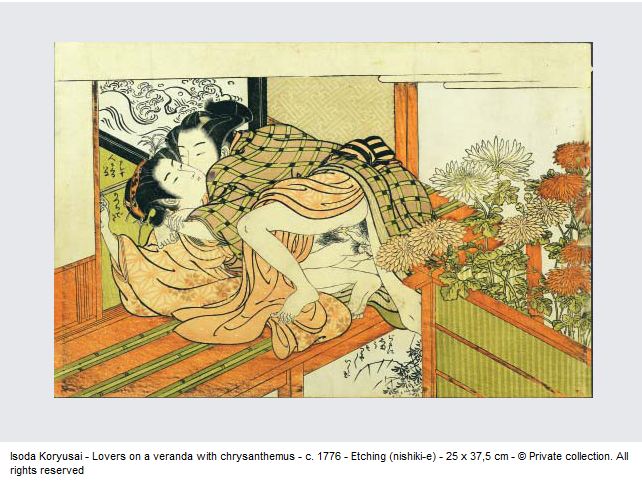
One of the highlights of the day was the newest exhibition revealing the erotic ukiyo-e Japanese woodblock prints which influenced Picasso’s later works.


“Picasso never parted with any of his Japanese prints. It would not be surprising, then, if they had proved to be a source of inspiration at one time or another. Whilst he always shunned any show of exoticism, in the last years of his life Picasso devoted himself, with total freedom, to representing scenes of sexuality, as though in exorcism of approaching death. The drawings and prints of those final years are every bit as bold as the shunga prints with which they establish a compositional and stylistic dialogue.” - Museu Picasso of Barcelona.


The Picasso Museum is currently preparing a major exhibition of linocuts and has asked Mr. Schwartz’s assistance due to his vast expertise in this area.


Later in the tour, Michael and Serra lectured on many topics including those as the Vollard suite and La Celestines; many of these prints which you can find at Galerie Michael today such as the ones shown below.


Picasso, La Celestine, 1968 Picasso, Portrait of Vollard, II, 1937


Wednesday, August 12, 2009

Miro Interpretation


Today the gallery was visited by a young artist accompanied by her family. Miss Godfrey was so kind as to draw up her interpretation of Joan Miro's art. This young artist might one day have a strong career in the art world! What do you think?