Showing posts with label Pierre-Auguste Renoir. Show all posts

Saturday, April 23, 2011

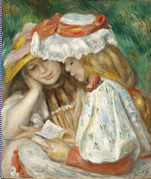
Two Girls Reading by PA Renoir


LACMA's Pierre-Auguste Renoir - Two Girls Reading Oil on canvas

Thursday, March 24, 2011

Enfant au Biscuit


"Jean Renoir, the artist's second son, is represented here nibbling a
biscuit. When this fresh and apealing portrait was made, the artist was living
with his family in Montemarte, in an old house known as the Chateau des
Bruillards. Jean Renoir later became a famous film director. He was born in
1894, the year in wich his father, Peirre-August Renoir, made the
aquintance of Ambrose Vollard (Also Picasso's Dealer). Renoir drew this
lithograph in 1898"


-- [Stella 31]

Thursday, March 11, 2010

The Boating Party


The Maison Fournaise

Parisians would flock to Chatou's Maison Fournaise to rent rowing skiffs, eat a good meal, or stay the night. In 1857, the entrepreneur Alphonse Fournaise bought land in Chatou to open a boat rental, restaurant, and small hotel for the new tourist trade. From the mid 1870s, Renoir often visited the Maison Fournaise to enjoy its convivial atmosphere and rural beauty. He painted scenes of the restaurant, as well as several portraits of Fournaise family members and landscapes of the surrounding area. In fact, Renoir occasionally traded paintings with the Fournaise family for food and lodging.

Renoir and Friends

Renoir's Luncheon of the Boating Party not only conveys the light-hearted leisurely mood of the Maison Fournaise, but also reflects the character of mid- to late-nineteenth century French social structure. The restaurant welcomed customers of many classes including bourgeois businessmen, society women, artists (Renoir and Caillebotte), actresses, writers (Guy de Maupassant), critics and, with the new, shorter work week--a result of the industrial revolution--seamstresses and shop girls. This diverse group embodied a new, modern Parisian society that accepted, as it continued to develop and advanced the French Revolution's promise of liberté, egalité, fraternité.

Chapeau Epingle

Pierre-Auguste Renoir
Chapeau Epingle, 1898
Lithograph
910108


Julie Manet, the daughter of Berthe Morisot the famous impressionist painter, and Eugene Manet, the brother of Edouard Manet was a favorite model of Renoir in his later years. “Le chapeau epingle” is a superb example of the artist’s delicate control of the line even at an advanced age. While many people identify Renoir as primarily a colorist, his delicate use the etching needle in this print testifies to his mastery of this medium

What makes “Le chapeau epingle” such an important print in Renoir’s oeuvre, is that it contains the key elements so often found in his best work; the young girls, the special moment, the soft gestures of the hands and faces, and the wonderful Belle-Epoque hats.

Pierre-Auguste Renoir Biography

RENOIR, Pierre Auguste (1841-1919)

Born in Limoges, France, Pierre Auguste Renoir moved to Paris with his family when he was just four years old. At the tender age of thirteen, young Renoir worked at a porcelain factory where he learned his earliest lessons of color and drawing and became a skilled decorator of fine china. The budding artist often visited the Louvre, which was still half-palace and half-museum. There the young budding artist began his formative studies of the French masters.

In 1862, Renoir joined the classical painting school of Charles Gleyre, where he met Alfred Sisley, Frédéric Bazille, and Claude Monet, who were all exploring plein air painting and studying the effects of color and light.

He first exhibited at the Paris Salon in 1864, but his recognition did not come for nearly a decade. Through the 1860s, he sometimes could hardly afford to even buy paints. Finally in 1874, he displayed six works at the first Salon des Réfuses, the pioneer exhibition of the Impressionists. With a new avant-garde audience, Renoir found acceptance and recognition of his extraordinary abilities.

Although he was one of the most controversial Impressionists, Renoir eventually established himself with the general public and eventually participated in the official Salons. By 1880, he also began concentrating on painting the female figure. But Renoir never gave up his roots as a traditional arts craftsman and as an admirer of the old masters. In the early 1880s Renoir had the feeling of exhaustion and that he had done everything he could do with Impressionist style.

Starting in 1881, Renoir traveled to Algeria, Spain, and Italy, absorbing the styles and techniques of Delacroix, Velazquez, Raphael, and Titian. Through the 1880s, he worked with the Italian style of restrained brushwork and empathetic modeling of subjects, focusing on details and more elaborate lines. In 1883, he spent a prolific summer painting at Guernsey, an island in the English Channel.

As Renoir matured, his style changed again, growing softer and more sketchily outlined. He used very strong colors—often reds and oranges—and thick brush strokes. His preferred subjects were voluptuous young female nudes.

Stricken with severe arthritis, by 1903 he was hardly able to hold the brush. Yet, still determined to paint, he resorted to strapping the brush to his wrist. This improvised technique affected his style in the last decade of his life, but it allowed him to continue painting through the last years of his life. At the end of his life in 1919, Renoir had the rare opportunity to see his own paintings hanging at the Louvre alongside the masterpieces that influenced him as a young boy.

Museum Collections include…

  • Art Institute of Chicago
  • Fitzwilliam Museum at the University of Cambridge
  • J. Paul Getty Museum, Los Angeles
  • Louvre Museum, Paris
  • Metropolitan Museum of Art, New York
  • Minneapolis Institute of Arts
  • Museum of Fine Arts, Boston
  • National Gallery of Art, Washington D.C.
  • National Gallery of Canada, National Gallery, London
  • Norton Museum of Art, Florida
  • State Hermitage Museum, Russia
  • Aberdeen Art Gallery and Museums, Scotland
  • Accademia Carrara, Italy
  • Appleton Museum of Art, Florida
  • Chrysler Museum, Virginia
  • Cincinnati Art Museum, Ohio
  • Cleveland Museum of Art, Ohio
  • Fine Arts Museums of San Francisco
  • Folkwang Museum, Germany
  • Joslyn Art Museum, Nebraska
  • Le Chateau-Musee de Dieppe, France
  • Montreal Museum of Fine Arts, Quebec
  • Musée d’Orsay, Paris
  • Musee des Beaux-Arts de Bordeaux
  • Musée Marmottan Monet, Paris
  • Museu Calouste Gulbenkian, Lisbon
  • Museu de Arte de Sao Paulo, Brazil
  • National Museum of Western Art, Tokyo
  • National Museum, Sweden
  • New Orleans Museum of Art, Louisiana
  • Norton Simon Museum, California
  • Portland Museum of Art, Maine
  • Reading Public Museum, Pennsylvania
  • Tel Aviv Museum of Art, Israel
  • Wadsworth Atheneum Museum of Art, Connecticut
  • Wright Museum of Art at Beloit College, Wisconsin

Renoir Family Tree